
Maybe you’re the friend who always wants to know why something happens to the human body. Maybe you’ve watched a nurse care for someone you love and thought, “I could do that.” Or maybe you want a career where helping people and earning a good living can go together.
If health science is on your college list, you have plenty of company.
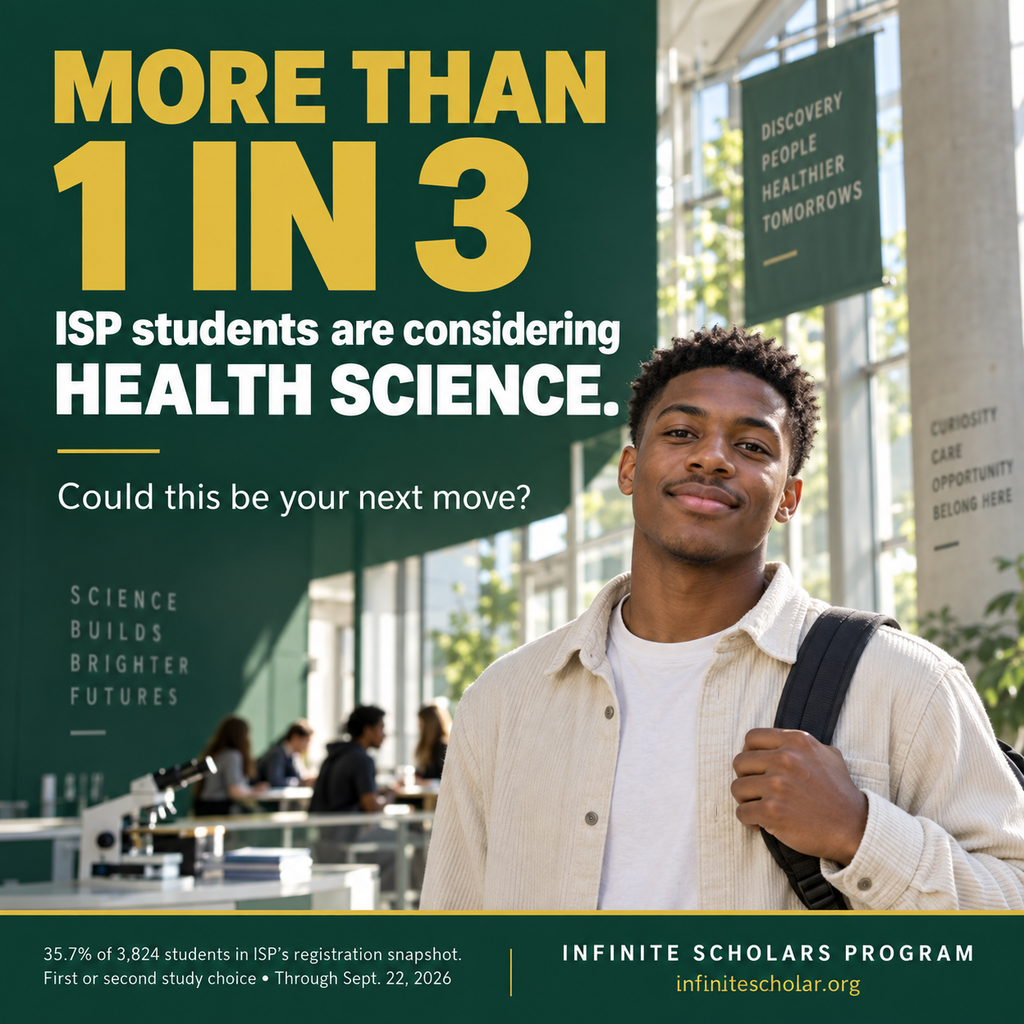
More than one in three ISP students—35.7%—selected Health Science as a potential field of study. That’s 1,364 of the 3,824 distinct students in our registration snapshot through September 22, 2026. It was also our most popular first-choice category.
That number represents students exploring their options. And exploring is exactly what you should be doing. Before you pick a college, order the sweatshirt and start imagining yourself in scrubs, let’s talk about where this path can take you.
What is a health science major, anyway?
Health science is the study of human health and how we help people live healthier lives. Depending on your college, you might study the human body, disease prevention, healthcare systems, community health or the business side of care.
Picture a hospital. Someone cares for patients. Someone operates imaging equipment. Someone helps a patient learn to move again. Someone teaches families how to manage their health. Someone keeps the entire operation running.
Those jobs belong to different professions, but they show how many directions an interest in health can take you.
A health science bachelor’s degree can help you explore those directions and prepare for certain jobs or further education. Colleges may offer different tracks; the University of Missouri, for example, has options focused on rehabilitation, health and wellness, leadership and preparation for professional school.
Here’s the detail to catch early: a health science degree alone does not make you a nurse, physical therapist or physician assistant. Those careers require specific professional programs and credentials. Start with the job you want, then find the degree path that gets you there.
Why are so many students interested in health science?
Our registration form tells us what students are considering, not their personal reasons. Still, the field has some clear attractions.
There is work to be done. The U.S. Bureau of Labor Statistics projects about 1.9 million healthcare job openings a year from 2025 through 2035. Those openings include new jobs and positions replacing people who leave the field. Opportunities vary by career and location, but healthcare has a substantial need for workers.
People need care at every stage of life. An aging population means more demand for healthcare and rehabilitation. New technology and changing ways of delivering care also require people who understand both the science and the systems behind it.
You can find a role that fits your interests. Love explaining things? Explore health education. Curious about technology? Look into medical imaging. Interested in leadership? Learn about healthcare administration. You can begin with an interest in health and then narrow your focus.
The impact is personal. Helping someone understand their care or regain their independence can make a workday meaningful. And yes, earning potential belongs in the conversation, too. You’re allowed to care about people and your future paycheck.
How many years of school are we talking?
A bachelor’s degree in health science usually takes four years of full-time study. Your credits, course load and program requirements can change that timeline.
After that, it depends on the career. Some students enter the workforce. Others continue to a master’s or doctoral program. Certain healthcare careers also offer specialized associate-degree routes, so a four-year health science degree may not be the most direct choice for every goal.
Choose the destination before you calculate the school years. A sonographer, nurse and physical therapist follow different training paths, even though all three help patients.
Health science careers and salaries: What could your future look like?
Here are six careers to explore. Some connect to a health science bachelor’s degree; others require a separate professional program.
| If you’d like to… | Explore this career | Typical education path after high school | National median annual pay |
|---|---|---|---|
| Help people understand their health and build healthier habits | Health education specialist | About 4 years for a relevant bachelor’s degree; certification may be required or preferred | $64,070 |
| Use ultrasound technology to help doctors see what’s happening inside the body | Diagnostic medical sonographer | Often about 2 years in a specialized associate program, plus prerequisites and applicable credentials | $96,590 |
| Care for patients and help families understand their care | Registered nurse | About 4 years for a BSN, one of the approved nursing routes; RN licensure required | $97,550 |
| Help people recover movement after illness or injury | Physical therapist | Commonly about 7 years: bachelor’s degree plus a Doctor of Physical Therapy; licensure required | $102,760 |
| Examine patients, diagnose conditions and provide treatment | Physician assistant | About 6–7 years: bachelor’s degree plus an accredited PA master’s; licensure and often prior healthcare experience required | $135,880 |
| Lead teams and help a healthcare organization run well | Medical and health services manager | Typically a 4-year bachelor’s degree plus relevant work experience; some roles favor graduate study | $123,860 |
Pay figures are U.S. Bureau of Labor Statistics national medians from May 2025. Education timelines are approximate; prerequisites, admission schedules and experience requirements can add time.
Before you build a budget around those numbers: a median is the midpoint of what workers earn. It is not a promised starting salary. Your experience, location, employer and specialty all matter. Management roles usually come after you build experience.
Dreaming of becoming a doctor? Plan for a longer commitment: typically four years of college, four years of medical school and three to nine years of residency, with additional training for some specialties.
How do you know if health science fits you?
You don’t need to have your whole life figured out before freshman year. You do need to be curious enough to investigate the work.
Ask yourself:
- Do I enjoy learning about science, health or how the body works?
- Would I rather work directly with patients, use technology, teach people or organize a team?
- How much school am I willing—and financially prepared—to complete?
- Can I picture myself doing the everyday work, including the difficult parts?
Then take the next step: talk to someone who does the job. Ask about a regular Tuesday. What takes up most of their time? What surprised them? What do they wish they had known in high school?
Shadowing or volunteering, where available and age-appropriate, can help you see whether the career fits the picture in your head.
Before you say yes to a college, check these details
Make sure the program leads where you want to go. Ask which jobs you can qualify for after graduation and which require more school. Admission to a health science major may be separate from admission to a nursing or other clinical program.
Ask about the required credentials. Have the college explain whether the specific program meets the education requirements for the license or certification you’ll need. “Our university is accredited” is only the beginning of that conversation.
Find out how hands-on learning works. Who arranges internships or clinical placements? Are there extra applications, costs or travel requirements? Those details can affect both your schedule and your budget.
Be honest about the commitment. Science classes, labs and clinical experiences take work. Some patient-care jobs involve long shifts and emotionally demanding situations. Understanding that now helps you make a stronger choice.
Let’s talk scholarships—because the plan has to be affordable
A college acceptance is exciting. Knowing how you’ll pay for the full path makes that excitement easier to enjoy.
Students and families should compare tuition, fees, books, equipment, transportation and any graduate school needed for the career. Ask whether a scholarship renews each year and what grades or enrollment status you must maintain.
If you’re considering community college first, ask both schools how your credits will transfer into your intended program. Get that information before choosing classes.
First in your family to explore college? You don’t have to arrive knowing all the terms. Ask the representative to walk you through the path from high school graduation to your first qualified job.
Bring these questions to your next Infinite Scholars fair
Save this list on your phone:
- “I’m interested in becoming a ____. Which program should I choose?”
- “What can I do with this degree right after graduation?”
- “Will I need another application or more school to enter that career?”
- “How do your students perform on licensing exams, and where do graduates work?”
- “What scholarships could I qualify for, and what would I still need to pay?”
You don’t need to walk into a college fair with every answer. Bring your questions, your interests and a willingness to learn. A useful conversation can help you turn “I think I want to work in healthcare” into a plan you understand.
Your interest is the starting point. Let’s help you find your next step. Visit infinitescholar.org to learn about Infinite Scholars college and scholarship fairs.
Register for one of our life changing fairs here! REGISTER NOW!
The Possibilities Are Infinite.

Sources
Sources checked September 23, 2026. Salary figures use May 2025 BLS national medians; projections use 2025–2035.
- University of Missouri: Bachelor’s degree in Health Science
- BLS: Healthcare Occupations
- BLS: Medical and Health Services Managers
- Colorado State University Pueblo: Health Science, BS
- BLS: Health Education Specialists
- BLS: Diagnostic Medical Sonographers
- BLS: Registered Nurses
- BLS: Physical Therapists
- BLS: Physician Assistants and Mayo Clinic: Physician Assistant Career Guide
- BLS: Physicians and Surgeons